"Mia: Don't you hate that?
Vincent: What?
Mia: Uncomfortable silences. Why do we feel it's necessary to yak about bullshit in order to be comfortable?
Vincent: I don't know. That's a good question.
Mia: That's when you know you've found somebody special. When you can just shut the fuck up for a minute and comfortably enjoy the silence."
Vincent: What?
Mia: Uncomfortable silences. Why do we feel it's necessary to yak about bullshit in order to be comfortable?
Vincent: I don't know. That's a good question.
Mia: That's when you know you've found somebody special. When you can just shut the fuck up for a minute and comfortably enjoy the silence."

But it is not only this mixture what makes the film special. It is also because of little details. It is on what we are going to focus. We can see, for example, how it reflects slight differences between American and European cultures. At the beginning of the film there are Vincent and Jules talking about Vincent’s trip to Amsterdam, and how they name McDonalds’ burgers in Europe. There is also the cab scene with Butch and the taxi driver, named Esmarelda Villalobos –I think there is a mistake on the name, it should be Esmeralda-. They both talk about each others’ names, and they realize that English names don’t mean anything and Spanish names have a meaning most of the times. These two little points make me think about how different we are depending on the culture we have been brought up, but how similar we can be at the same time. Nowadays world globalization is more of a reality than a dream. We can find pizza or kebab all around the world, communication travels incredibly fast and also do people. Long distances seem to be shorter nowadays. But, even though there are plenty of reasons to consider total globalization as a fact, we must take into account a very important factor. The roots of different world cultures are there and had been forged over centuries, so it is impossible to make big changes from one day to the next.
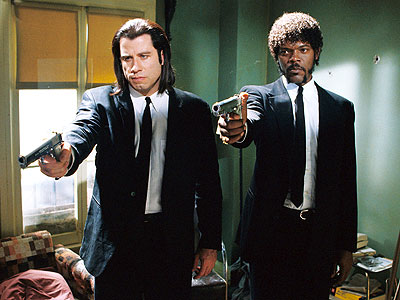
Coming back to the film, we can appreciate that every character let us know its personality by means of the dialogues and behavior. A clear example of this is Jules Winfield and his religion. He is strictly religious, but, ironically, he recites Ezekiel 25:17, the bible passage, every time he is about to kill someone (and everybody knows it is a sin to kill people). We might think it is just Tarantino playing with the character, but we can also think that religion is not interpreted the same way in America than in Europe, which drives us straight to what we were saying before. We have the same impression at the end of the film, in the restaurant, where Jules says that the ‘bullet thing’ was a miracle, like a God intervention, but Vincent thinks it was just coincidence.
To sum up, I hope this reflection make you see that not only spectacular plots, scenery, dialogues and actors, but also little and special details are needed to turn a film into a masterpiece.
Say something, say something.
